 WhichBroker
Dettaglio del punteggio
I punteggi seguono la nostra metodologia pubblica — commissioni 30%, piattaforme 20%, affidabilità 25%, mercati 15%, assistenza 10%. Come valutiamo
Cosa ci piace
- ISA, SIPP e ISA junior senza costi di conto nel piano gratuito Basic
- Zero commissioni e nessun canone di piattaforma: le azioni britanniche costano solo lo 0,5% di stamp duty
- Di proprietà dall’aprile 2025 di IG Group, società del FTSE 100, con tutela FSCS sugli investimenti fino a £85.000
- Fondi comuni, gilt e buoni del Tesoro accanto a oltre 9.000 azioni ed ETF
A cosa fare attenzione
- Il cambio valuta dello 0,99% nel piano gratuito rende care le azioni USA; anche Plus (0,39%) costa più di Trading 212 (0,15%)
- Gli interessi sulla liquidità non investita sono limitati a £1.000–£3.000 a seconda del piano
- Niente supporto telefonico, orari della chat limitati e nessun drawdown nel SIPP (solo UFPLS, £240 ciascuno)
- Grafici e tipi di ordine essenziali; niente CFD, opzioni o conto demo
The UK-first investing app
Freetrade was incorporated in London in September 2015 and built its brand on a single idea: UK investors should not pay a dealing commission to buy shares. A decade later it says it has more than 1.6 million users, and since 1 April 2025 it has been wholly owned by IG Group, the FTSE 100 trading company, which announced the deal on 16 January 2025. IG’s full-year results for the year to May 2025 reported Freetrade revenue of £29.1 million and said the deal added 457,300 active customers.
The pitch today is narrower and sharper than Trading 212’s. Since 22 January 2026 the stocks and shares ISA, SIPP and Junior ISA are all included in the free Basic plan, along with mutual funds, gilts and ready-made portfolios. Freetrade says it is the only UK platform offering a free ISA, pension and Junior ISA. What it charges for is currency conversion, and that is the number that decides whether Freetrade suits you.
Plans and accounts
Freetrade sells three subscriptions over the same four accounts: a general investment account (GIA), a stocks and shares ISA, a Junior ISA and a SIPP.
| Plan | Price | FX fee on non-GBP trades | Interest on uninvested cash |
|---|---|---|---|
| Basic | free | 0.99% | 1% AER on up to £1,000 |
| Standard | £4.99/month billed annually (£59.88), or £5.99 monthly | 0.59% | 2.5% AER on up to £2,000 |
| Plus | £9.99/month billed annually (£119.88), or £11.99 monthly | 0.39% | 3.5% AER on up to £3,000 |
Dealing commission is £0 on every plan. Plus adds priority customer service and free same-day withdrawals, and paid plans add enhanced stock fundamentals. The pricing page lists recurring, limit and stop-loss orders and extended-hours trading in its feature table; check which plan unlocks each before you rely on one.
Opening an account happens in the app or on the web: personal details, National Insurance number for the ISA and SIPP, and an identity check. Freetrade does not state an account minimum, and its SIPP charges schedule says fractional share investments start from £2.
What it actually costs
The fee table is short, which makes the trade-off easy to see.
| Cost | Freetrade |
|---|---|
| Dealing commission | £0 on all plans |
| ISA, SIPP, Junior ISA account fee | £0 on Basic since 22 Jan 2026 |
| FX on US and other non-GBP shares | 0.99% Basic / 0.59% Standard / 0.39% Plus |
| UK share purchases | 0.5% stamp duty (a government tax, not Freetrade’s) |
| Transfers in or out of the SIPP | free; no exit fee |
| SIPP withdrawals | £240 per UFPLS withdrawal; no income drawdown or annuities |
| Interest on SIPP cash | none |
Interpretation: buying £1,000 of a UK share costs £5 in stamp duty and nothing else, the same as everywhere. Buying £1,000 of a US share costs £9.90 on Basic, £5.90 on Standard and £3.90 on Plus. The same purchase costs £1.50 at Trading 212 and £5 at XTB. Freetrade’s own illustration, a £10,000 GIA making one £250 UK trade and one £250 US trade a month, comes to £29.70 a year on Basic, all of it FX.
So the arithmetic is simple. If your portfolio is mostly UK shares, UK-listed ETFs and funds, Freetrade is as cheap as any platform we score, and the free SIPP is a genuine advantage. If you mainly buy US stocks, you are paying for conversion on every trade, and even the Plus plan’s 0.39% is more than double Trading 212’s 0.15%. Our fee score of 8.4, against Trading 212’s 9.3, is that difference. The full cross-platform maths is in The cost of buying US shares from the UK.
The SIPP has one structural limit worth knowing before you transfer a pension in: Freetrade does not offer income drawdown or annuities. You can take lump sums as UFPLS withdrawals at £240 each, or transfer out free of charge to a provider that offers drawdown.
The app
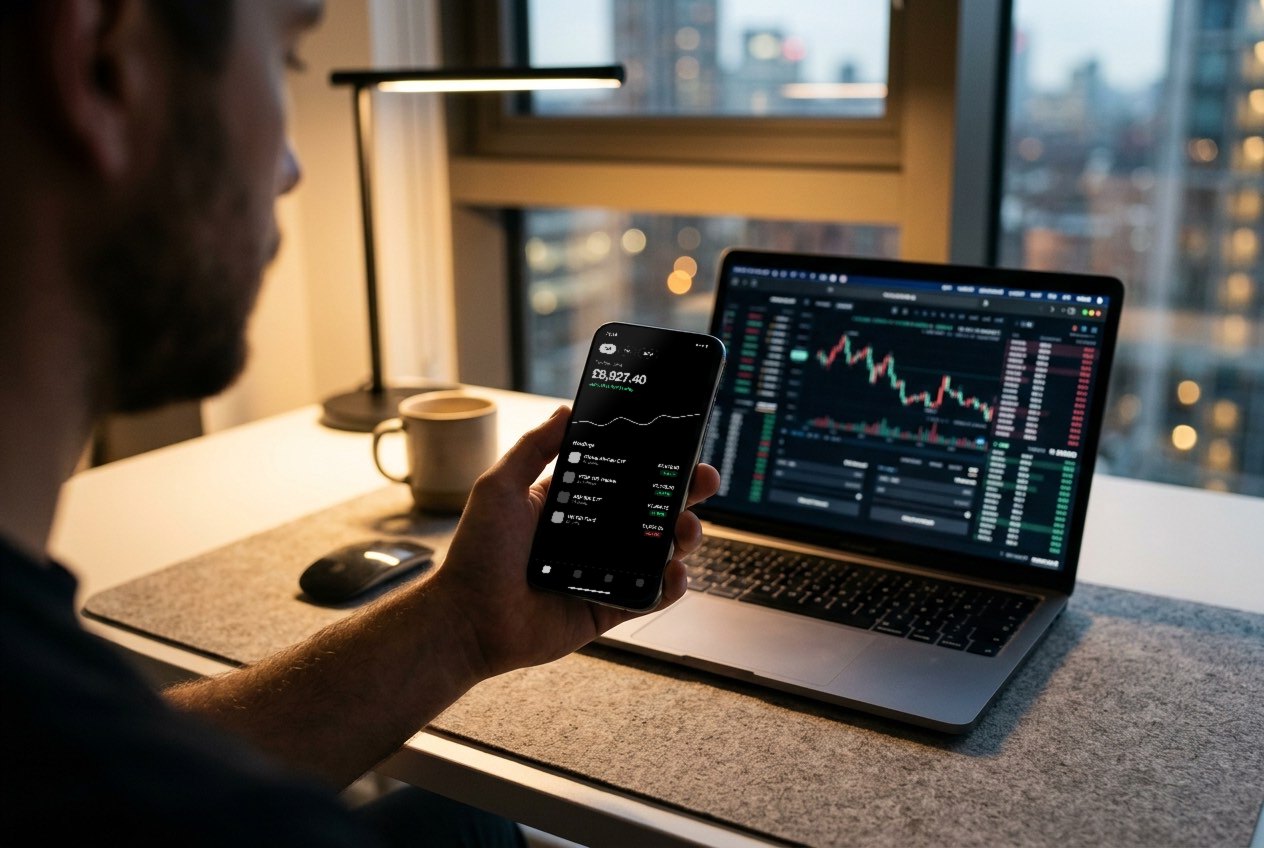
Freetrade is an investing app, not a trading terminal, and it is designed that way. The core is a clean portfolio and watchlist view, search across 9,000+ stocks, ETFs, funds and investment trusts, US fractional shares, plus gilts and UK Treasury bills, which most commission-free apps do not offer. Ready-made portfolios give beginners a starting point. A web platform sits alongside the iOS and Android apps.
What it lacks is depth. Charting is basic, there is no demo account, and there are no CFDs, options or spot crypto, only crypto ETNs, which the help centre notes are not FSCS-protected. Our platform score of 7.8 puts it below Trading 212’s 8.4, mainly because Trading 212’s Pies & AutoInvest and multi-currency account do more for an investor who automates.
Safety and FSCS cover
Freetrade Limited is authorised and regulated by the FCA (firm reference 783189) and is a member firm of the London Stock Exchange. It is registered in England and Wales as company 09797821. Its safety disclosures describe the standard UK platform structure:
- Client money is held in dedicated client money accounts, separate from Freetrade’s own funds.
- Investments are registered to a separate nominee company, Freetrade Nominees Limited. Its help centre states that liquidators may not use assets held in that name to pay Freetrade’s debts, and that this is mandatory under the FCA’s CASS rules.
- Reconciliation is daily, with regular third-party audits. Freetrade’s safety page names PwC; an older help-centre article names Deloitte.
- FSCS cover: eligible investments are protected up to £85,000 and eligible cash deposits up to £120,000 per person, per institution. Freetrade’s learn page notes the deposit limit rose from £85,000 in December 2025. The FSCS pays out if the firm fails and assets are missing, never for market losses.
The IG ownership changes the picture more than any single rule. A venture-funded fintech is now part of a FTSE 100 group founded in 1974, and Freetrade’s own disclosure says that if IG could not support it, accounts would likely be transferred to another provider under the regulator’s oversight. That is why our trust score is 8.8, above Trading 212’s 8.2, though below listed brokers with longer records such as XTB.
The usual warning applies: capital is at risk, the value of investments can fall as well as rise, and you may get back less than you put in.
Support
Support is in-app chat and email, and Freetrade’s terms state that it does not offer phone support. Its help centre gives chat hours of 8am to 9pm on weekdays and 10am to 5pm at weekends, with longer hours for Plus members. That is thinner than the 24/7 chat at Trading 212, and the main reason for our 7.3 support score. The learning library is good on UK specifics, with calculators for the ISA, SIPP, pension tax relief and gilts.
Verdict
8.2 / 10. For a UK investor who wants a free ISA and SIPP for UK shares, funds and gilts, Freetrade is the most complete free offering we have scored, and IG’s ownership removes most of the old doubts about its staying power. For anyone whose portfolio is mostly US stocks, the 0.99% FX fee is the deciding fact, and Trading 212 vs Freetrade shows how quickly it adds up. Investors who want a listed broker with a proper trading platform should read XTB vs Freetrade. For the full UK ranking, see Best trading platforms UK, and for ISA-specific comparisons, Best stocks and shares ISA.
Domande frequenti
Is Freetrade safe?
Freetrade Limited is authorised and regulated by the FCA (firm reference 783189), is a member firm of the London Stock Exchange and has been wholly owned by FTSE 100 IG Group since April 2025. Client cash is kept in segregated client money accounts and investments are registered to a separate nominee company, Freetrade Nominees Limited, so they are not available to Freetrade's creditors if it fails.
How much FSCS protection does Freetrade have?
Freetrade's safety page says eligible investments are protected up to £85,000 and eligible cash deposits up to £120,000 per person, per institution, under the Financial Services Compensation Scheme. That covers losses if Freetrade fails and assets are missing, not falls in the value of your investments. Crypto ETNs are not covered by the FSCS.
Is the Freetrade ISA really free?
Yes, on the Basic plan. Since 22 January 2026 the stocks and shares ISA, SIPP, Junior ISA, mutual funds, gilts and ready-made portfolios are all included in the free Basic plan, with no account fee and no dealing commission. The costs you still pay are the FX fee on non-sterling trades (0.99% on Basic), 0.5% stamp duty on UK share purchases, and any fund's own charges.
What is the Freetrade FX fee?
It depends on your plan: 0.99% on the free Basic plan, 0.59% on Standard (£4.99 a month billed annually) and 0.39% on Plus (£9.99 a month billed annually). The fee applies to every trade in a non-sterling stock, such as a US share, so buying £1,000 of a US stock costs £9.90 on Basic, compared with £1.50 at Trading 212.
Who owns Freetrade?
IG Group Holdings plc, the London-listed FTSE 100 trading company founded in 1974. IG announced the acquisition on 16 January 2025 and completed it on 1 April 2025. Freetrade continues to operate under its own brand and its own FCA authorisation.

Apri il sito ufficiale — verifica le condizioni attuali per il tuo paese prima di depositare.