 WhichBroker
Score breakdown
Scores follow our public methodology — fees 30%, platforms 20%, trust 25%, markets 15%, support 10%. How we score
What we like
- Instant, fee-free withdrawals around the clock — genuinely rare
- $10 minimum deposit makes it accessible anywhere
- Publishes monthly trading volumes and audited financials voluntarily
What to watch
- Narrow instrument range beyond forex and metals
- Retail clients in many regions served by offshore entity
- No stock investing, CFDs only
Who Exness is actually for
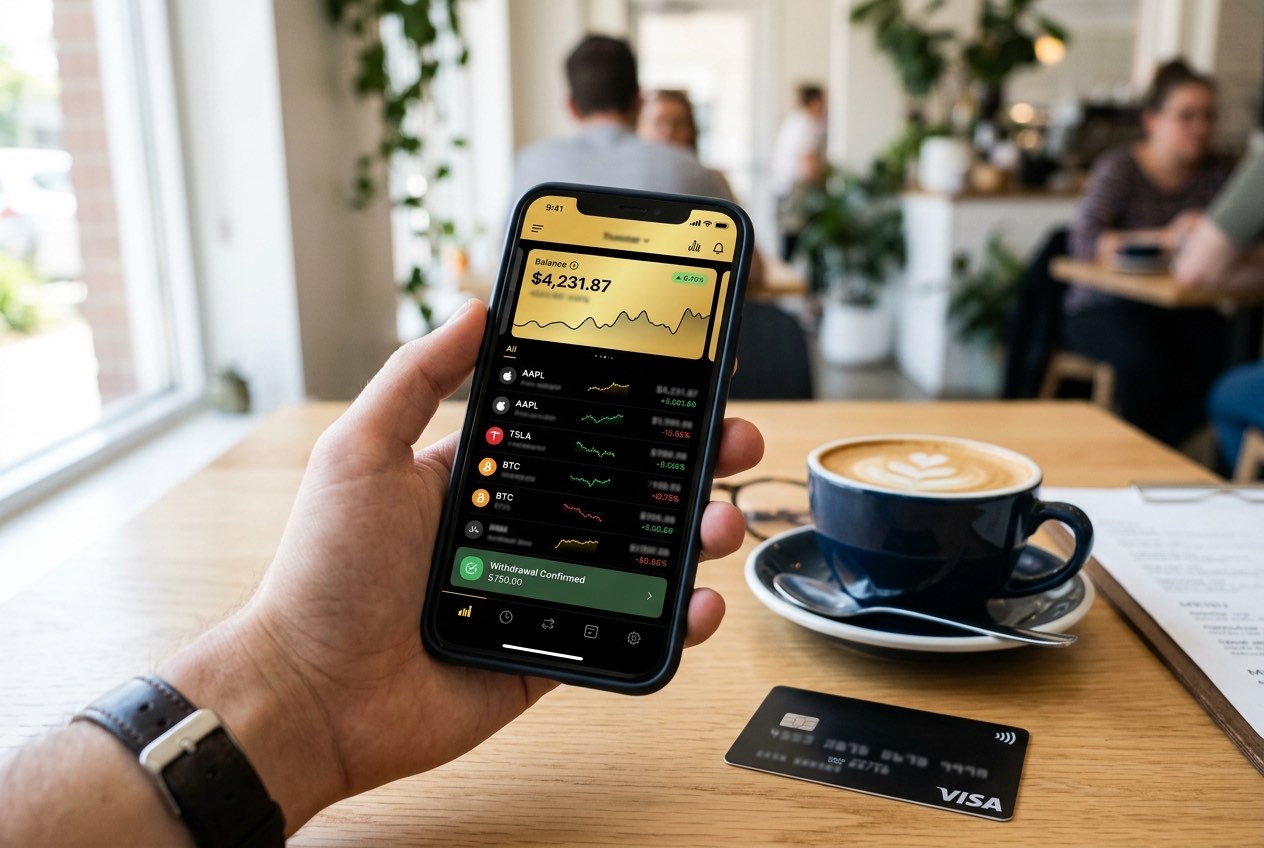
Every broker claims to make deposits and withdrawals painless. Exness built its entire reputation on it. Withdrawals are processed instantly, around the clock, without fees — including weekends, when most competitors’ finance departments are asleep. For traders in emerging markets who move money in and out weekly, that single feature explains why Exness voluntarily publishes some of the largest monthly trading volumes in the retail industry.
The profile that fits: an active forex or gold trader who values execution mechanics, low entry requirements and fast access to their own money. The profile that doesn’t: a long-term investor who wants to own shares or ETFs — everything at Exness is a CFD — or a trader who wants a wide multi-asset menu. With roughly 250 instruments concentrated in forex, metals, crypto, energies, indices and a modest list of stock CFDs, this is a specialist’s toolkit, and our market-range score of 7.4 reflects that deliberately narrow shelf.
Opening an account: the $10 on-ramp
Account opening is one of the fastest in the industry. Registration takes minutes, and the Standard account requires only a $10 minimum deposit — low enough to test the platform with real money without meaningful risk. Verification (proof of identity and address) can be completed after registration, though deposit and withdrawal limits stay restricted until it’s done, so it’s worth uploading documents immediately.
Exness structures its offer around two families of accounts:
- Standard accounts — no commission, spreads from around 0.2 pips on majors, $10 minimum. The sensible default for most traders.
- Professional accounts (Raw Spread, Zero, Pro) — spreads from 0.0 pips with a commission, or commission-free “Pro” pricing with instant execution. Higher minimum deposits apply; these exist for scalpers and high-volume traders who calculate costs per lot.
Which entity onboards you depends on your country — and that matters more than the account type. Exness holds licenses from CySEC (EU) and the FCA (UK), but retail clients in much of Africa, Asia and Latin America are served by entities regulated in the Seychelles (FSA) or South Africa (FSCA). The trade-off is real: offshore entities allow higher leverage but come with weaker investor-protection schemes. Check which entity appears in your account agreement before funding — it defines your compensation rights, not the logo on the website.
Trading: MT4, MT5 and the in-house terminal
Exness supports the full MetaTrader ecosystem — MT4 and MT5 with expert advisors, custom indicators and algorithmic trading — plus its own Exness Terminal in the browser and the Exness Trade app on mobile. The in-house terminal is cleaner than MetaTrader and perfectly adequate for discretionary trading; serious algo users will stay in MT5.
Execution quality is where Exness invests its marketing credibility. The firm publishes monthly trading volumes and tick-level data voluntarily, and standard accounts get market execution with no dealing-desk intervention on most instruments. Stop-out levels are unusually forgiving (as low as 0% on some account types, meaning positions are closed only when margin is fully exhausted), which experienced traders treat as a feature and beginners should treat as a warning: it lets losing positions run to the very end of your balance.
Leverage deserves its own caution. Offshore Exness entities advertise leverage up to 1:2000 — and effectively “unlimited” leverage under specific conditions. At 1:2000, a 0.05% move against you wipes out the margin on a position. European and UK clients are capped at 1:30 by regulation; everyone else should self-impose something similar until they have a tested strategy.
Fees, honestly
| Cost | Standard account | Professional accounts |
|---|---|---|
| EUR/USD spread | from ~0.2 pips (typically ~1.0) | from 0.0 pips |
| Commission | none | varies by account; charged per lot on Raw Spread |
| Deposits | free (method-dependent) | free |
| Withdrawals | free, instant | free, instant |
| Inactivity fee | none | none |
| Overnight swaps | standard; swap-free available in many regions | standard |
The absence of deposit, withdrawal and inactivity fees is genuinely rare, and swap-free status is available broadly rather than only for religious-exemption accounts. The honest caveat: “spreads from 0.2 pips” is a floor, not an average — typical Standard-account spreads on majors sit near 1 pip. High-volume traders should price a Professional account against Pepperstone or IC Markets per traded lot; the raw-spread specialists remain slightly tighter at scale. See the direct matchup in Pepperstone vs Exness.
Safety: transparency as a substitute for tier-one everywhere
Our trust score of 8.0 balances two truths. On the positive side: Exness has operated since 2008, holds CySEC, FCA, FSCA and FSA licenses across its group, publishes audited financials and monthly volumes voluntarily, and segregates client funds. Very few privately held brokers offer this much visibility.
On the cautious side: the FCA and CySEC entities serve a minority of its global client base. Most retail traders sign with the Seychelles entity, where the regulatory safety net — compensation schemes, leverage caps, complaint procedures — is thinner. Exness’s scale and track record mitigate that, but a UK client under the FCA and a Nigerian client under the FSA are not buying the same protection, and no amount of published volume changes that.
CFDs are leveraged instruments: a majority of retail investor accounts lose money trading them. The forgiving stop-out levels and extreme leverage available offshore amplify exactly this risk.
What’s missing
- No real asset ownership. No shares, no ETFs, no bonds — CFDs only. Investors should look at XTB, which pairs CFD trading with genuine stock investing (comparison: XTB vs Exness).
- A narrow shelf. ~250 instruments against 1,200+ at Pepperstone and 6,700+ at XTB.
- Education is thin. The learning resources are functional but far from the structured academies competitors run; beginners get a low entry price, not a curriculum.
- Support quality varies by language and region, though 24/7 availability and a responsive chat earn Exness an above-average 8.6 support score.
Verdict
Exness does the unglamorous parts of brokerage — funding, execution mechanics, withdrawals, cost transparency — better than almost anyone, and prices it fairly from a $10 minimum. It loses points where it chooses not to compete: instrument breadth, investor protections outside its European entities, and education. For an active forex or metals trader, particularly in the regions Exness serves best, it is an easy platform to recommend with the leverage warning attached in bold. For investors and multi-asset traders, the specialists’ trade-offs point elsewhere.
8.4 / 10. Consider Pepperstone for tighter raw pricing under tier-one regulation, or XTB if you want real stocks next to your CFD account.

Open the official site — check the current terms for your country before depositing.